Wednesday, June 8, 2011

The User’s Review: Canon EOS 750, released 1988

This is a simple review on a simple EOS camera body.


EOS 750 is the first body with a built-in flash in the Canon EOS family. Do you know if this model is the first slr with a built-in flash?


When the flash switch is in auto position and if needed, the flash will pop up, fire and close itself automatically.


The camera is easy to use, only with a shutter release, a flash switch, and a control dial of 4 gears (battery check, program, DEP and self-timer).

The User’s Review: Canon EOS 10s (10, 10 QD), released in 1990

When I first saw an EOS 10s body, I could not figured out the functions of the button under the lens release and the bar sign on the control dial.


If you answer a 'yes' to the following questions, you may need such a body to shoot your film.


Q1, Bar-coding program? Yes, through the bar-code receptor under the lens release. A bar-code reader is used to scan the bar codes in a booklet, and input into the camera to program the modes. The Canon EOS Barcode Reader E and Program Book are needed.


Q2. Interval timer? Yes. Remember there are two timers in this body. Use the interval one to take up to 36 pictures at any interval up to a period of 23:59:59 (almost one day). This timer makes the camera perfect for sequences, flowers blooming, or group pictures that need more time that allowed with the self-timer.


Q3. Infrared film use? Yes.


Q4. Auto pop-up/close of the flash via a button? Yes.


Other features include: 1/4000 s shutter speed, 8-zone light metering, 3 selectable focus marks, multiple exposure, shake warming, 14 custom functions (I used CF 2 to set 'film leader out'), DX-code overriding, and an unique shoulder pad anchoring a viewfinder cover on the camera strap.

Tuesday, May 31, 2011

The User’s Review: Three Types of Front Lens Caps

I like to put a front cap on my camera lens when I do not shoot. Over the years, I have noticed that there are three types of caps on my cameras and lenses.

'Push-on' type: made of metal, plastic or rubber. My dad's old Zenit C has a metal one produced in late 1950s or earlier 1960s. In mid 1980s, he brought me my fist slr camera, Yashica Fx-3, from Hong Kong. It has a short-range zoom with a plastic front cap. This type of cap is simple, just a cover without any lock function, but no more common these days.

'Center-pinch' snap-on type: a common type today. See the Nikon one in the following image. Do you know why it's common? I believe, when you have a lens hood on your lens/zoom, you will figure out youself. Your fingers can easily reach the center-pinch to put on or take off the cap within a hood. Due to the structure on the caps, they often are thicker than the other two types.


'Clip-on' type: you need to press the two 'buttons' along the outside edge of cap when installing/taking off it. The structure on this type of cap is simpler, so they are thinner.  

The User’s Review: Canon Zoom Lens EF 28-105mm 1:4-5.6 vs. 28-90mm 1:4-5.6 III


Similarities: 1:4-5.6; midrange zoom from 28mm; macro; plastic mount; 58mm filter; similar size when fully retracted.


Differences: 

EF 28 – 105 mm
EF 28 – 90 mm III
Longest zoom mm
105
90
Macro m/ft
0.48/1.6
0.38/1.3
Shortest at moom length mm
28
50
Longest at moom length mm
105
90
Focus ring
Stable
On the front piece and move
Front piece
Not turning and moving with the focus ring
Turning and moving with the focus ring
Rear lens
Sealed on the barrel
Move with internal barrel


Conclusions: I prefer the 28-105mm zoom. It has 1) a wider zoom range, 2) internal focusing (lens length will not change with focusing), and 3) sealed rear end to avoid dust into the barrels from this end.

Monday, May 30, 2011

The User’s Review: Minolta Maxxum 7 (Dynax 7, α 7) 35mm Film SLR Camera, released in 2000

The Japanese version, alpha 7, was the winner of the 18th Camera Grand Prix in 2001 (and is the last film camera winning the award). As I understand, all versions are the same functionally, except the middle name (Alpha, Dynax, Maxxum; correct me if not).


This Dynax 7 got in my hands in July 18, 2011

Where was the Dynax 7 made? In Japan?
Check the bottom label of Maxxum 7, see the differences?

Technically, the 7 is one of the most advanced SLR cameras ever built. It features two LCD screens (the small one on top and big one on film door), 1/8000 s shutter speed, wireless flash control, 14-segment honeycomb-pattern metering system and depth-of-field (when paired with Minolta D-type lenses) displayed on the big LCD. If the 7 is new to you, don’t forget to get a copy of the 203-page instruction manual.


Other features I like include ‘eye stat’, AF/MF switch (no matter which focus mode is set), custom-assigned functions of two control dials, central button for quick selection of center focus point, four flash modes, Japanese-type slide doors of the contacts for remote cord control and batter and control grip, many function controls on the battery grip VC-7 (3 buttons, 2 dials and 2 switches), 35 custom functions (I set Custom 3 to 2 for film leader left out of the cartridge), memory function to store camera settings and to download via the Data Saver DS-100 for 400 – 1900 rolls of film (I have no such saver and no need for the data to keep). 


The 7 is well built (8.8 on 10-point scale), but not very solid and durable. My main concern is the film door with the big LCD and many controls. The door surface, I mean the rubber layer, is worn easily and become sticky on some bodies. There is only one latch to lock the door (carefully close the door, you do not want to break it). The film door has a sophistical lock system, which has malfunction in some bodies to block the door to open. Read the manual troubleshooting section to see how to open the door if any malfunction. The grip VC-7 is relatively rear to find and expensive, often a used one is more than USD 100 (vs. 160 – 200 for a used Maxxum 7 body).    


A wireless remote to control the camera? No, sorry.

As far as I know, there are two versions of α 7, regular and golden. What I don't know is if there are any difference except the colors. I guess it's just a matter of marketing.


Want to see more of a Dynax 7, click here.

The following are an article on Maxxum 7 from Pop Photo and Minolta ad for Maxxum 7.


Sunday, May 29, 2011

The User’s Review: SMC Pentax DA 1:4-5.6 50-200mm ED Zoom Lens

I brought this zoom and a 18-55 II together as in-good-condition used online, and paid USD 100 including shipping on March 3, 2011. Believe it's a good deal. Had an article on the 18-55 II lens and the kit lens in my K-x.


This 50-200 zoom is compact, quick, quite and easy to use. It has the function of quick shift (QS, The lens releases the gear with the focus-driving motor in camera body and allows manual adjustment of focusing once the auto-focusing finishes). The lens surface is also marked both zoom and distance scales, but no magnification scale on the barrel.

With a metal mount, this lens was built of three layers of barrels. The front/most internal one does not turn while focusing. If you buy new, it should come with a hood. I would rate its build quality at 9 on a 10-point scale.

I used it to shoot kids and got satisfied images from my K-x.

Thursday, May 26, 2011

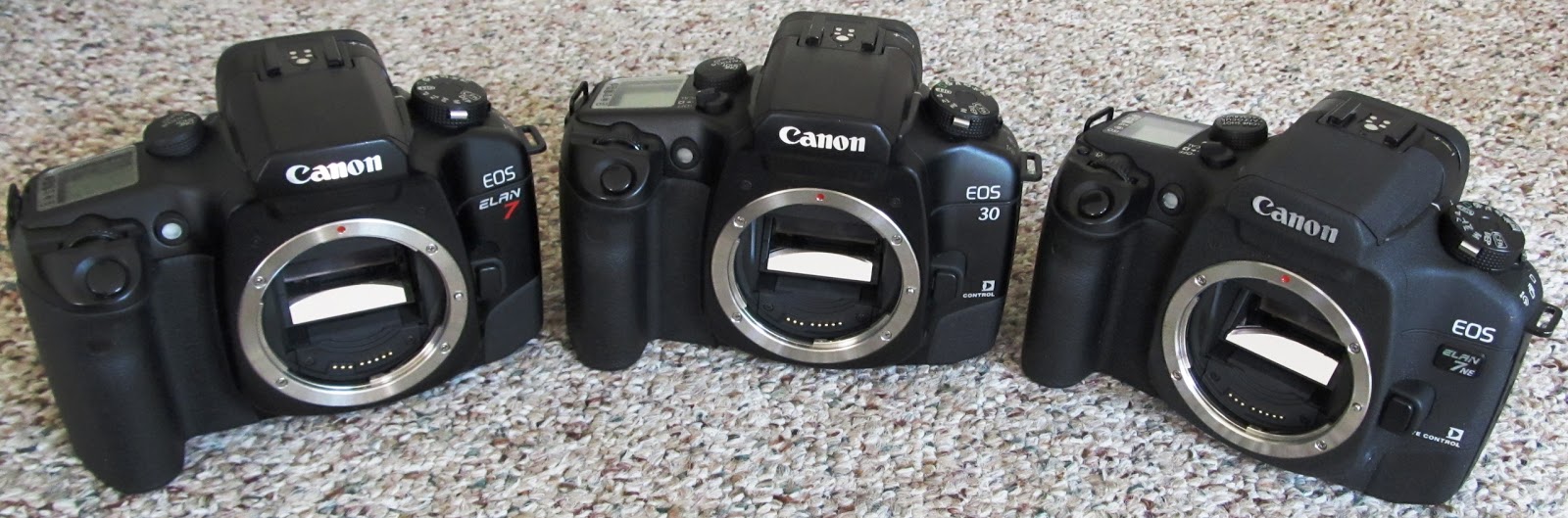
The User’s Review: Canon EOS Elan 7(33), 7E (30), 7N (33V) and 7NE (30V, 7S)


Elan 7/7E and 7N/7NE were released in 2000 and 2004, respectively. EOS 7S is the JDM version of Elan 7NE Date. They are midrange bodies in EOS family, with pentaprism viewfinder, 1/4000 s shutter speed, and metal lens and tripod mounts. With many shared parts (such as back film door, eyepiece cup and more), the four models look similar, except finer and smoother texture surfaces of top and front panels on 7/7E than on 7N/7NE (the panels are made of aluminium), sliver color of LCD frame on 7/7e vs. black frame and backlight of LCD on 7N/7NE. On the two top dials of 7N/7NE, marked letters are elevated rather than printed as on 7/7E. Furthermore, under the hood, 7N/7NE have an upgrade AF system and E-TTL flash metering system.


Although AF points increase to 7 in 7/7E and 7N/7NE (vs. 3 in Elan II/IIE and EOS 55), the eye-controlled DOF as in Elan IIE disappeared in 7E and 7NE. The vertical dial on the back door (Quick Control Dial named by Canon) was not passed on to later Canon EOS T2 and EOS DSLR. In stead, some Canon DSLR bodies have a horizontal rear dial like those on Nikon N80, N75 and Minolta Maxxum 7.


Build quality of 7/7E and 7N/7NE are very good. The big eyepiece cup fits well to my glasses and sunglasses. If possible, get a body with the eye-control, which is amazing. By May of 2011, I have not seen any Canon DSLR with the eye control. All models numbered by 7 have both wireless remote and electric cord controls. I prefer them, but other brands such as Nikon N80 still use the traditional screwed-on shutter release cable.


The Japanese version, EOS 7s, has a date back. It's very rare in North America. According to the manual on Canon website, the date versions of 7NE and 30V also exist. I saw a 30V Date on ebay, but have not seen any 7NE Date yet. 

If you are looking for a mid-range-price 35mm film camera body, consider/test these Elan 7/7N bodies before you buy.