Monday, February 20, 2012

The User's Review: Nikon FM SLR Camera Manufactured during 1977 - 1982


I got mine with several Nikon EM bodies, each priced at USD 4 plus shipping.


The wind lever is at a position locking the shutter button to fire. 

The red circle indicates the wind lever unlocks the shutter button.  Multiple exposure is achieved by pushing/holding the round button behind the speed dial  to the left and then winding. It says that there are two versions of FM, with different rings around the shutter button and different ways to activate an attached motor drive. Mine should be a latter version with a stronger internal structure.

To open the film door, you need to push the button by the rewinding knob backward and to pull it up.  

The FM sign is engraved on the back of top plate under the wind  lever


The small window under the letter k in 'Nikon' is used to pick up aperture number on a lens. FM has a viewfinder showing aperture size on the top, shutter speed on the left, and light meter (+ o -) on the right.

Self-timer and DOF preview lever

This image shows Version 1 of FM. See the differences?


Saturday, February 18, 2012

The User’s Review: How many versions of Kyocera/Yashica Samurai X3.0 released since 1987


I saw an old Samurai X3.0 invoice that priced the camera with a case at USD 342.88 in 1988.

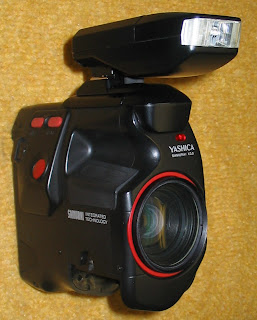
Yashica was one of the most active manufactures in production of 35mm half-frame cameras. Among its half-frame models, Samurai X3.0 is Yashica’s first with autofocus. As I understand, X3.0 indicates the zoom range (25 – 75mm, 25 X 3 = 75). Inside X3.0, film runs vertically, making the SLR body like a video camera. However, the vertical transportation of film was not new to Yashica, which had a Sequelle (1962) with a similar system.

The author, , wrote a wonderful blog article on Samurai  in Chinese language at www.blog.dcview.com. This review talked about the functions of all four models of Samurai. By following the Samurai X3.0 online, I found that there were also many versions of X3.0 out there. As I learned, X3.0 was first sold as Kyocera Samurai X3.0, which had at least three color versions of main switch, zoom buttons and lens ring in either black, red or green. Soon later, Yashica Samurai X3.0 took the place of the Kyocera. Yashica Samurai X3.0 also has the color versions, but they are different from the Kyocera ones by having a flash mount on the top.  Some Yashica Samurai X3.0 missed the flash mount plate on the top. However, the four screw holes should still be seen there. To me, the attached flash capability should not be in the original design because, with the extra flash installed and the in-body flash blacked by the plate, the in-body flash still fires when using the external flash.

There are also three versions of battery cover for X3.0, making the camera look different. Most importantly, an unique version, specially assembled for me, equipts a hand strap with a pad on the battery cover. Yes, this version of battery cover was manufactured by Yashica, but for Samurai X4.0. I find that its cover with hand strap fits onto my X3.0 and is more comfortable to hold the camera.

As both Camerapedia and Subclub mentioned, there were both left and right hand versions available. I see only the right hand ones. If you happen to own a left hand version, please confirm me. BTW, the X3.0 manual says that two hands are needed to hold and operate the camera. If the zoom button were moved to the finger pad by the lens, one-hand operation/hold was possible. Moreover, a clear version was also made for demo, Subclub also says.

Finally, what I want to mention is the so-called golden model of ‘Grand Prix 88 ’. Actually, it IS the Yashica Samurai X3.0, and is a special version with the golden buttons and ring, produced after the model won the 5th Camera Grand Prix in 1988 (http://www.cjpc.jp/past_gpxE-01.html.  Now called the Camera of The Year since 2008). 


Three versions of battery covers


The shoe-mount flash in 'off' position
The shoe-mount flash in 'on' position
The eyepiece cup is listed for X4.0 in its manual,
but can be used on X3.0 

Two versions of Samurai X3.0 cases. The hard case with a
wider shoulder strap on the left is for the golden X3.0.

This should be the original Kyocera Samurai without
flash mounting plate and screw holes on its top.

Friday, February 10, 2012

The User’s Review: The "Wink Mirror" Topcon Uni/Hanimex Topcon RE Auto/Beseler Topcon Auto 100, The First TTL-AE SLR Camera, Released in 1964 and Priced Under USD 160


First of all, the price. USD 160 in 1964 should be worth more then USD 900 in 2010. Topcon The camera WAS NOT cheap by then. At the time of my blog on the model, the camera can be purchased at ~ USD 20 in USA. The relative value of the 20 from 2010 ranges from $0.91 - 3.52 in 1964, according to measuringworth.com. 

Next is about the names. Topcon is the body's manufacture in Japan, Hanimex and Beseler are the importers in Australia and USA.

Finally, comes to the tech. value of the camera. In terms of photographic technology, the model was markerly innovative when born in 1964. It is the first SLR camera with through-the-lens auto-exposure (TTL-AE, Topcon called it as full automatic with behind-the-lens meter). The light sensor, which can be seen through the lens mount and is like a spider net, is printed on the mirror, and the exposure is controlled by a leaf shutter. Based on the light sensor distribution on the mirror, I am pretty sure that it’s an average, not spot, metering.


The camera top is pretty simple, with only film transporting system. However, the lens mount section is more complicated, with extra rings for shutter and film speed settings. With the ASA settings, it seems to me that the model is compatible only with lenses that have the largest aperture 2, 3.5, or 4. As I know, the three lenses released with Auto 100 are of 1:2 53mm, 1:3.5 35mm, and 1:4 135mm.  The camera’s AE is in a shutter priority mode. On the other side of the camera, after opening the film door, you will see the back of the mirror, instead of shutter blades or curtains in most other SLR cameras.


The frame counter is on the left by the rewind crank. The counter location is not common, usually on the right side.


Due to the unique design, the Auto 100/Uni/RE Auto work only with Topcon UV lenses. With my Topcon Auto 100, I do not have many options for lenses. These lenses could be cheap or expensive, decided by the sellers.

Auto 100 is not very reliable. Common issues with an aging camera are non-working shutter and aperture.Basically, the problems are associated with the movements of the blades/leaves.


Opened battery chamber and film door release button on the right.


An unique design and site of shutter release button by the lens mount on right.

Rings of shutter speed, ASA and aperture are piled from the body to lens mount. Note that there are only three marks 2, 3.5 and 4 to set ASA. Does this mean that only lenses with these values of maximum aperture can be used? How to set teh ASA for Topcon 1:2.8 50mm lens, which I saw online?  


Light sensor is printed on the mirror. Meter needle and aperture scale are on the left side in the viewfinder.  


Topcon called it a MXV switch, which is used for M anx X flash synch, and  self-timer V.  X should be set for normal use as the manual says. It's the only switch that I can not figure out its functions on Auto 100 without reading its manual.

Topcon Auto 100 / Uni has a leaf shutter, which allows electronic flash synch at all speeds (up to 1/500 sec. on the body). However, with flash bulbs, the user has to know the bulb type and to match it to a suitable speed in a table in the manual.

It said that three lenses, 35, 52 and 135 mm were released with Auto 100. I have the first two. 


The front cover accepts only the 53mm lens that is the shortest among the available lenses. 

A leather case, well made.

The case has three colors, brown, dark brown or black.

This drawing comes from Topcon Auto 100 manual, showing how the camera works.

Topcon Uni

Hanimex Topcon RE Auto
As I observe, here is how the camera works. There are three items in the light pathway before the 35mm film: mirror with sensor, blade shutter behind the speed dial, and the blade aperture (the first two items are inside the body and the last one is inside the lens). In a idle status, the mirror is down to block film from exposure, shutter and aperture are widely open. When the shutter is pressed, a serial actions happen along the light pathway. The shutter makes the first close, aperture stops down and the mirror turns up; Once the mirror leaves the light pathway, the shutter opens  again for B - 1/500 sec, whatever the speed (time period) is set,  then closes again; The mirror falls down back to block the light pathway; Finally, both the shutter and aperture open to return to their idle positions. I am not sure the real stop-down phase of the aperture, but at least the stop-down during the shutter opening between its two closes in the process.