Tuesday, January 8, 2013

The User's Review: Konica Hexanon 47 - 100 mm F3.5 zoom, Released in 1965?

The interesting thing about this zoom is of all metal (except the rear cap), and compact size. It says that is designed for half-frame picture shooting in Konica Auto Reflex or Auto Reflex P series, but I do not have the zoom manual nor test the zoom for a full frame shooting. Interestingly, when I compared mine and the images of buhla, there is no yellow 'SIZE 24x18' warning sign on my copy with a higher SN on the front ring. Do not know if there was any modification over the production period of the zoom?

This zoom is well made, with three layers of barrels. The outer two barrels turn and move for/backward when focusing and zoom. The distance scale is marked in both 'metre and feet' (To me, the English grammar here is not consistent, should use the words metre/foot or metres/feet'). The filter size is 52 mm, smaller than most of my Konica lenses with 55 mm filter size. Internally, the zoom has six aperture blades. Some users claimed that there is a matched hood for this zoom.


Wednesday, January 2, 2013

The User's Review: Vivitar 55 mm 1:2.8 Auto U Mount Lens, With A Unique Aperture Ring

Aperture ring on a lens/zoom evolves over the years, from a ring with aperture values, auto-gear/lock ring to no ring on a current digital lens. However, this Vivitar lens has a unique ring, which can be turned to both sides for auto or manual aperture sizes. The 'auto' here means that the aperture keeps open at 2.8 until the shutter button is pressed and the aperture reduces the size you set during the exposing.


The lens front piece turns during focusing. The lens length extends a little bit when focused to the shortest distance

There are five aperture blades, which do not form a regular-shape hole at the smallest aperture setting.


Monday, December 31, 2012

The User's Review: Konica Shoe-Mount Light Meter, Made in 1950 - 1960?


This Konica meter by Konishiroku is more similar to the newer version of Sekonic meter, but with a different front plate, light sensor cover and fixed shoe position.

The User's Review: Sekonic Shoe-Mount Light Meter, Released in 1950 - 1960?

I got two such shoe-mount light meters made by Sekonic. The features that I like on these meters are: incident or reflected readings, adjustable position of the foot on the meter, and zero screw. 

There are some minor changes between the two meters. I refer them as the newer version (sn 081sss) and older version (sn 025sss)

 On the newer version case, 'Made in Japan' is marked on the back.


 The newer version (left) has a red needle with a mirror background.


 In the two images above, the newer version is on the right. The newer version has labeled 'Made in Japan' on its bottom metal plate and has a strap ring on its foot.

In this image, older and newer versions are on left and right, respectively. 

Konishiroku also produced a Koinca meter, more similar to the newer version of Sekonic here.

Friday, December 28, 2012

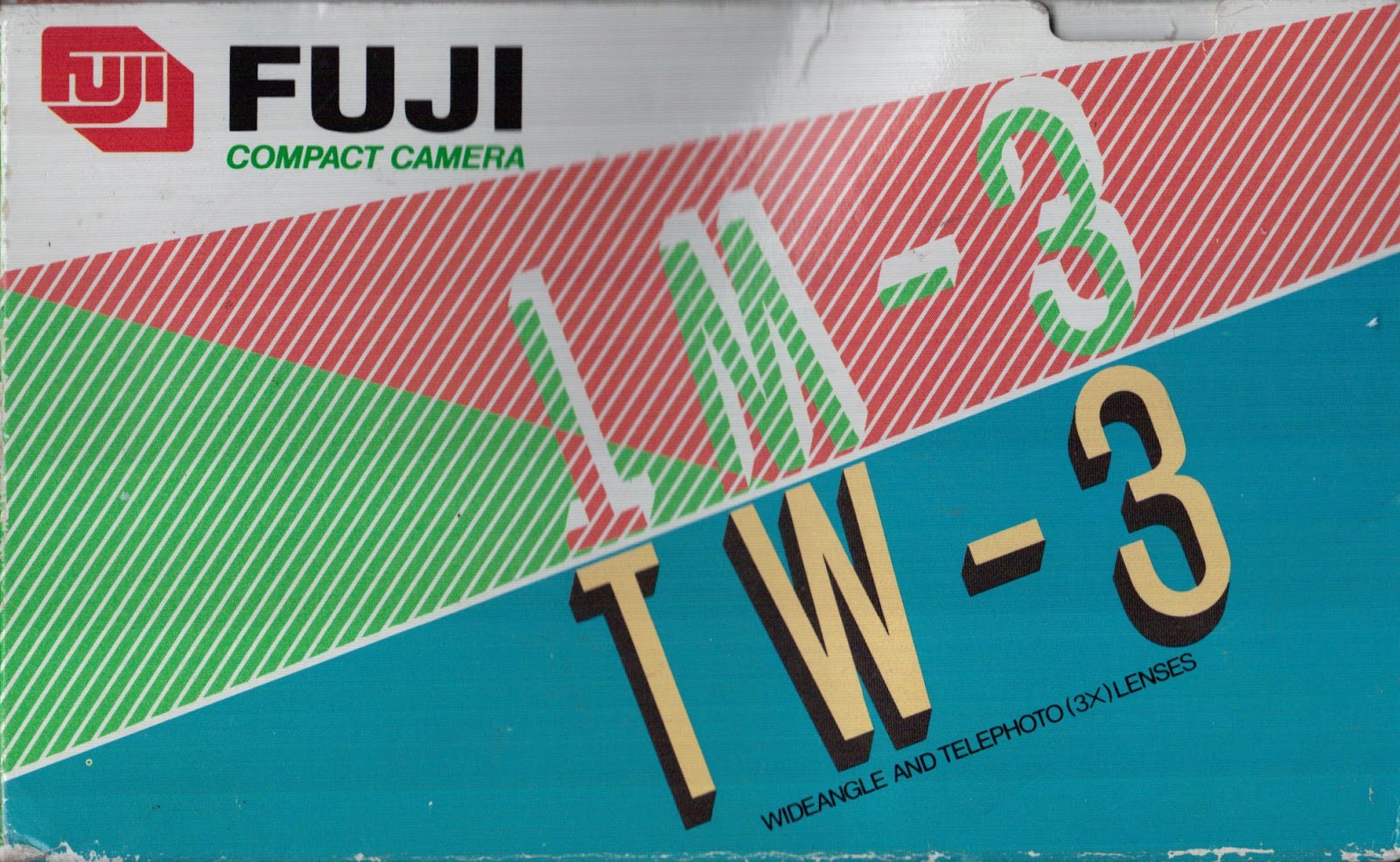
The User's Review: Fuji TW-3 Half-Frame 35 mm Compact Camera, Released in 1985


Today, TW-3 is a collector's item because of its rareness. Why it's rare, I believe, this is due to its unique design that caused its low demand in the market and limited production by its manufacture.


The unique design includes:
1. Compact body by the 1980's standard
2. Half frame of 35 mm film
3. 2 sets of lenses: telephoto (69 mm, 1.8) and wideangle (23 mm, 1.8).
4. Sealed battery chamber, meaning that its users can not change the battery by themselves after ~ 1000 shots (= ~ 14 rolls of 36 exp film, I doubt if this is a design by Japanese?)

The front lens cover has three positions to turn: Off 

The front lens cover has three positions to turn: Wideangle lens and auto-lift flash

The front lens cover has three positions to turn: Tele lens


The viewfinder is too small to be comfort for a user like me wearing glasses. At the tele lens, a smaller bright-green frame will show up in the viewfinder to indicate the image edges. 

The battery holder is on the left. Film will be pre-loaded onto the roller above the lens.

At the wideangle lens, the flash is up and the mirror (on the left of the lens) covers the light path from the tele lens.

At the tele lens, the mirror is open and light comes in via the tele lens

Recently I bought a TW-3 with its original package including box, manual and service card. This card is necessary since its users need to locate a service and have the battery changed. The manual had been damaged by water at some point of its history and certain pages stick together. I tried to separate them and ruined some areas. I scanned the English section of the manual and post it below because no such thing can be found in other places online. Hope the scanned materials are helpful to my readers.


With TW-3 and Konica AA-35 side by side, the later is smaller and thinner.


Am I happy to own a TW-3? Yes, because it's rare.
Do I like to use my TW-3? No, because it's unique design.
Should I recommend a TW-3 to you? It's up to you.