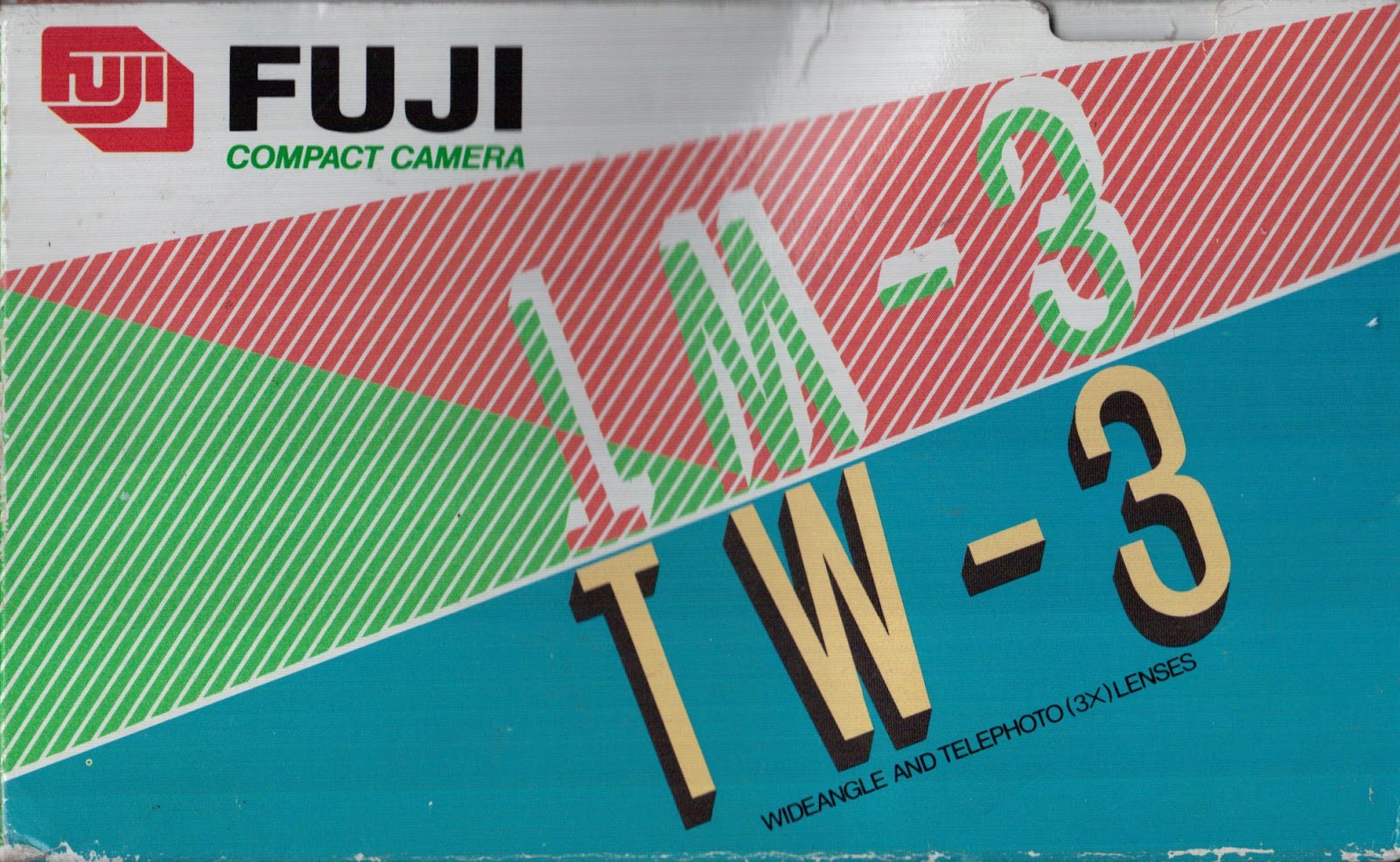
Today, TW-3 is a collector's item because of its rareness. Why it's rare, I believe, this is due to its unique design that caused its low demand in the market and limited production by its manufacture.
The unique design includes:
1. Compact body by the 1980's standard
2. Half frame of 35 mm film
3. 2 sets of lenses: telephoto (69 mm, 1.8) and wideangle (23 mm, 1.8).
4. Sealed battery chamber, meaning that its users can not change the battery by themselves after ~ 1000 shots (= ~ 14 rolls of 36 exp film, I doubt if this is a design by Japanese?)
The front lens cover has three positions to turn: Off
The front lens cover has three positions to turn: Wideangle lens and auto-lift flash
The front lens cover has three positions to turn: Tele lens
The viewfinder is too small to be comfort for a user like me wearing glasses. At the tele lens, a smaller bright-green frame will show up in the viewfinder to indicate the image edges.
The battery holder is on the left. Film will be pre-loaded onto the roller above the lens.
At the wideangle lens, the flash is up and the mirror (on the left of the lens) covers the light path from the tele lens.
At the tele lens, the mirror is open and light comes in via the tele lens
Recently I bought a TW-3 with its original package including box, manual and service card. This card is necessary since its users need to locate a service and have the battery changed. The manual had been damaged by water at some point of its history and certain pages stick together. I tried to separate them and ruined some areas. I scanned the English section of the manual and post it below because no such thing can be found in other places online. Hope the scanned materials are helpful to my readers.
With TW-3 and
Konica AA-35 side by side, the later is smaller and thinner.
Am I happy to own a TW-3? Yes, because it's rare.
Do I like to use my TW-3? No, because it's unique design.
Should I recommend a TW-3 to you? It's up to you.