Wednesday, December 7, 2011

The User’s Review: Sigma Zoom Lens 35 -135mm 1:3.5 -4.5 MC Macro for Minolta Sony AF-α

It's heavy because it's built with metal and glass. Feel much more solid than any current versions of zooms from the same manufacture.


Saturday, December 3, 2011

The User’s Review: Ricoh KR-30SP Program 35mm camera released in 1985

To me, the self timer on KR-30SP is unique. When holding the camera to shoot, the self timer is reachable by your left hand. It's a red light/button. Press it to start the timer and it begins to blink. If you change your mind after stating, press it again to stop. Simple and straightforward.

I may keep one of this Ricoh model because its shooting modes including program (P), speed program (SP, faster than 1/125),  speed or aperture priority. A data back (XR) and motor-driven grip (XR winder 2) are also available for KR-30SP.

There are more info showed on the right side of viewfinder. However, it's too dark to read in the dim situation. You have to turn on an illustrator by pressing a button on the left side of lens mount, under the self-timer.


The User’s Review: Ricoh XR-2s and Sibling Sears KS Auto 35mm camera released in 1979

One good thing with many Ricoh/Sears SLR bodies is that they accept Pentax K-mount lens. Actually, Pentax is under Ricoh now.

I am interested in the following features on XR-2s:

1. K-mount SLR body.


2. A internal curtain of viewfinder (a lever beside the eyepiece). You do not need a cover, which is easy to loose.

3. DoF preview and multiple exposure (unlock the ME lock, press the button both under the film advance lever before winding film)

4. A bright scale of shutter speed in the viewfinder.

The green round button needs to be pressed in order to turn the shutter speed dial away from 'Auto' gear.
The small window in the center of the plate under Ricoh label picks up the aperture size on the lens and shows it on the top of viewfinder.


Battery is needed to operate the shutter. Without battery power, the shutter works only at 'X' on the speed dial, which is 1/90 s.


The ME lock is in the locked position to avoid multiple exposure accidentally.
The viewfinder eyepiece blind lever is in the close position.
What I do not know is the function of a possible lamp in the lower left corner of the viewfinder window.
Let me know if you know. Thanks.


 It's elder brother, XR-2 introduced in 1977, can't work with the optional winder.

Friday, December 2, 2011

The User's Review: Kitstar Zoom Lens 80 - 200mm 1:4.5 Macro for Kinoca

Had a chance to have this lens for free. It's of a Konica AR mount. Looked for its info online, but not much. With it in hands, here are the features I summarized:
  
1. Kitstar was a trademark, probably manufactured in 1970s - 1980s. Correct me if not.

2. This lens has a ring outside the front element. This ring services as a hood when extended.

3. The macro ring, once unlocked from the normal position, can be used as a fine adjustment of foucing besides the ring of zoom/focusing.

4. The lens length does not change with zoom, but changes with focusing; and the front element rotates with focusing.

5. The aperture ring has a AE lock.


Friday, September 23, 2011

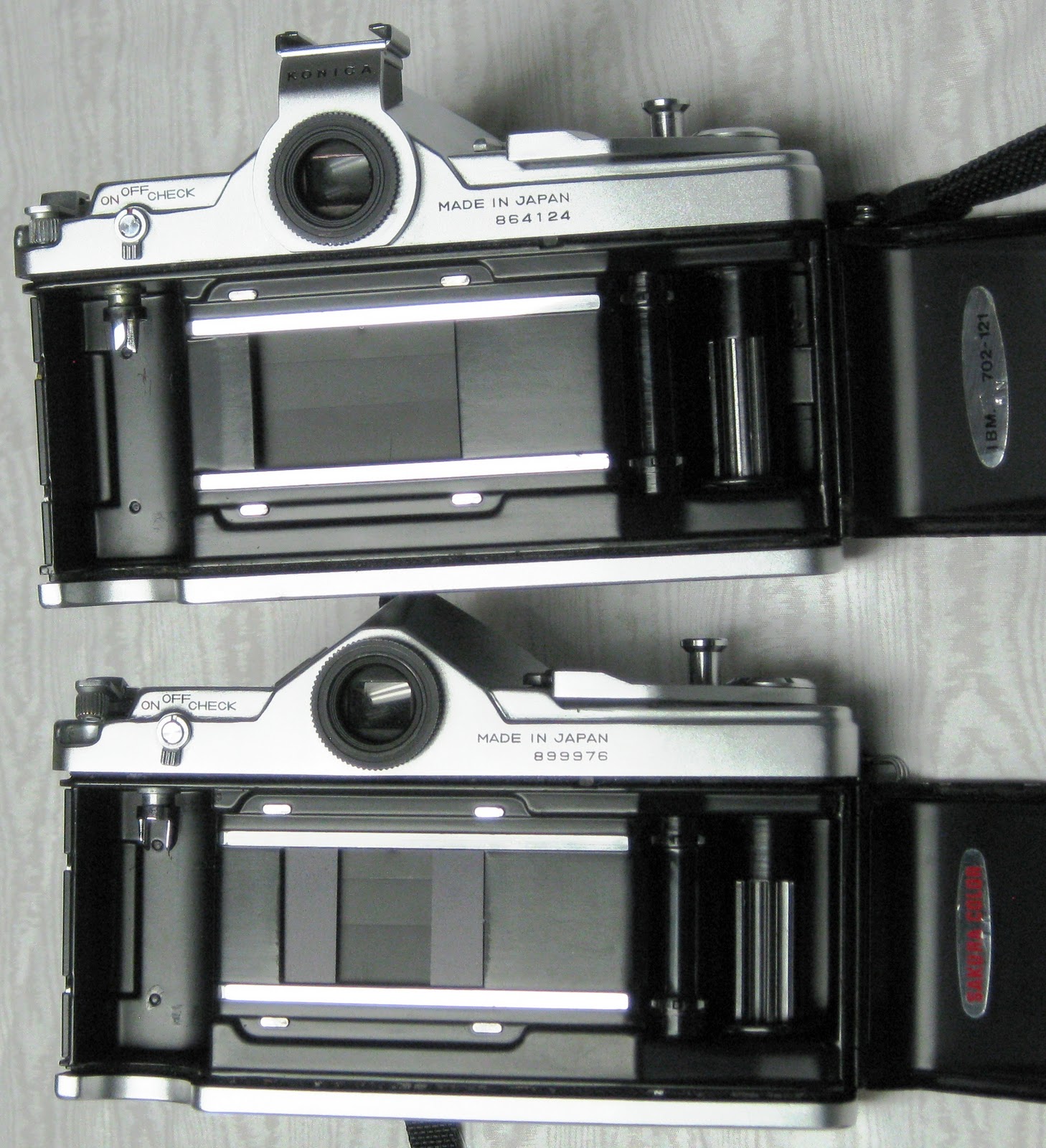
The User’s Review: Konica Auto-Reflex Full and Hall Frame SLR Camera, released in 1966

It's big, heavy and loudly, but unique for its full and half frame switch whenever you want. To my knowledge, the Auto-Reflex is one of the three camera models that can take full and half frames. The other cameras are Konica IIIm, a rangefinder, and Canon's Multi Tele, a point-and-shoot.

The removable 'cold' shoe

The light window on the right side of the 'roof'allows light to show the aperture settings in the viewfinder. 


The full and half frame switch

The full and half frames

The meter and meter window

A long shutter release is a obverse feature of Auto-Reflex

The meter switch and battery check

Two versions of battery cover. The top one was found on a camera with a higher SN.

Two versions of top cover of the case. I believe that the version on the left  was designed for Autoreflex P with the light meter III.

Three versions of bottom of the case: the top two are different from the bottom one, and the top one has a metal core inside that is much heavier than the others. I think, the bottom one was designed for Auto-reflex P without the meter/battery check switch. 

All versions of case have a label at bottom, showing how to switch between full and half frames. The bottom piece with a camera also can be screwed onto a tripod.


In the States, Konica Auto-Reflex was sold with f1.4 or f1.8 lens in two kinds of kits.