Saturday, February 22, 2014
Tuesday, February 4, 2014
The User's Review: 2 Versions of SMC Pentax-M 1:2 50mm Prime Lens
I have two copies of this prime lens with SN 39xxxxx and SN 79xxxx. Both made in Taiwan.
I found 5 differences when comparing them side by side in the following images with the earlier version on left.
1. Check the aperture blades in the first and last images. I am not sure if the blades can be installed facing either direction.
2. See the barrel surfaces around the white balls in the second image.
3. 'Made in Taiwan' marked on different locations in the third image.
4. On the lens' mounts, the cuts for lens lock have different shapes in the last image.
5. The diameters of their rear openings are different in the last image, bigger in the earlier version.
I found 5 differences when comparing them side by side in the following images with the earlier version on left.
1. Check the aperture blades in the first and last images. I am not sure if the blades can be installed facing either direction.
2. See the barrel surfaces around the white balls in the second image.
3. 'Made in Taiwan' marked on different locations in the third image.
4. On the lens' mounts, the cuts for lens lock have different shapes in the last image.
5. The diameters of their rear openings are different in the last image, bigger in the earlier version.
There is another difference that I can't show in the images. That is the weight. The earlier and later ones are 170 and 145 g, respectively, because it says that the later version has a plastic barrel.
Thursday, January 30, 2014
The User's Review: Two Editions of Pentax K1000 SE, Brown VS. Black
During the long production period of 21 years, Pentax released two special editions (SE) of K1000. The earlier edition (my SN 64039br) is more special with the brown color skin and is rare to find. The later SE (my copies' SN 74519bl and 81675bl) has the same black skin like the regular K1000. Both SE bodies have a split-image focus screen and the sign of 'SE' on their right front shoulders.
My SE K1000 cameras have a stick on their bottom plates, saying 'BODY ASSEMBLED IN HONG KONG'.
Friday, January 24, 2014
The User's Review: Yashica 635 TLR Cameras with Yashikor or Yahsinon Lenses
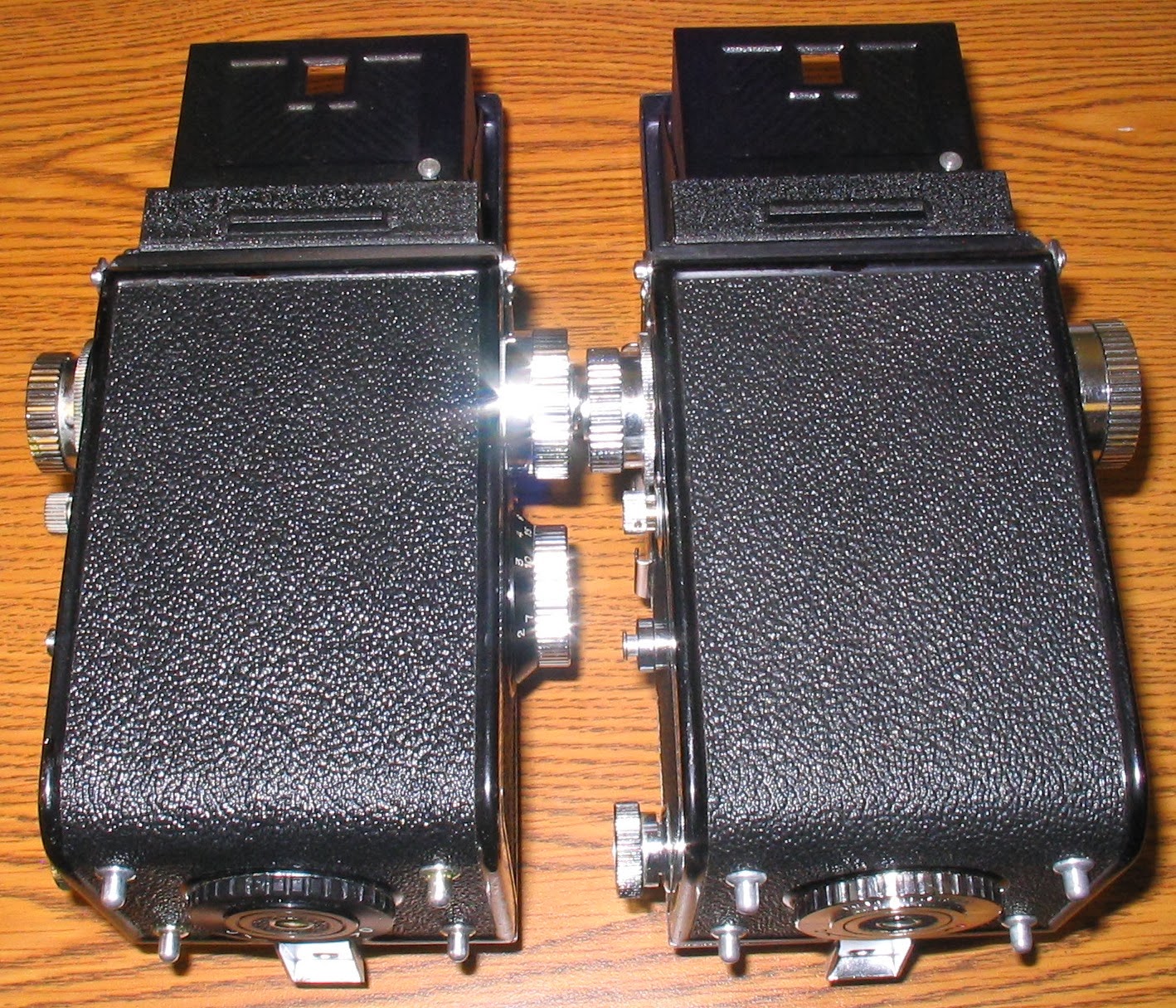
Some people claimed that the Yashikor is sharper, and preferred for portrait. Here I have both cameras, one with Yashikor lenses (right in the images below), and the other with Yahsinon lenses (left), showing their differences.
The specifications of the picture-taking lenses are Yashikor 1:3.5 f=80mm and Yahsinon 1:3.5 f=80mm, respectively. Furthermore, the viewing lenses are more different with Yashikor 1:3.5 f-80mm and Yashinon 1:2.8 f=80mm. On the view/focusing screen, the effect of the differences is minor in my eyes. I feel that the screen behind the Yashinon 2.8 lens is slightly brighter in dim light situations. There is another obvious difference between the two cameras in my images above. Can you tell? A good thing is that Butkus has the manuals for both cameras free online. These manuals also show the variations of Yashica 635 with Yashikor (the grey-cover manual) and Yashinon (the yellow-cover manual) lenses.
I have another blog on Yashica 635 and its 35mm film adapter.
The specifications of the picture-taking lenses are Yashikor 1:3.5 f=80mm and Yahsinon 1:3.5 f=80mm, respectively. Furthermore, the viewing lenses are more different with Yashikor 1:3.5 f-80mm and Yashinon 1:2.8 f=80mm. On the view/focusing screen, the effect of the differences is minor in my eyes. I feel that the screen behind the Yashinon 2.8 lens is slightly brighter in dim light situations. There is another obvious difference between the two cameras in my images above. Can you tell? A good thing is that Butkus has the manuals for both cameras free online. These manuals also show the variations of Yashica 635 with Yashikor (the grey-cover manual) and Yashinon (the yellow-cover manual) lenses.
I have another blog on Yashica 635 and its 35mm film adapter.
Tuesday, January 14, 2014
The User's Review: Access P-MC Wide-Auto Macro Lens, f 28 mm, 1:2.8, Ø 49 mm
This camera lens came to me with another one that I
intended to purchase. However, I found that this Access lens was unique once it
was in my hand. Its front element can be turned ~ 90˚ in order to set the macro
function at various scales of 1:6, 1:5, 1:4 and 1:3.7. On the other hand,
the front element does not rotate when focusing. Great!
| My copy of the Access is of Minolta M/MD mount. |
Thursday, October 31, 2013
The User's Review: Konica Hexanon Zoom/Zoom-Hexanon 80-200 mm 3.4
There are five versions of this zoom according to buhla.de. Here I have the first and fourth versions. The tripod mount socket on the later version is closer to the lens mount, this may be better to balance the zoom and camera on a mono/tri-pod. The glass in my copy of the first version becomes yellowish through age (the last image).
Thursday, September 26, 2013
The User's Review: Nikon N60 35 mm Film AF Camera, Manufactured between 1998 and 2001
This body feels bigger in my mid-size hand, sharing the eye-piece rubber but not the battery cover with N80.
Subscribe to:
Posts (Atom)