Thursday, March 28, 2013

The User's Review: Konica SLR Viewfinder Magnifier

When shooting with a body without AF and split-image focusing screen or in low light, this device will be much helpful. It's great for portrait, not for sport or fast-moving objects, because you may need to flip up the magnifier to compose your image.

Without the adapter, the magnifier can be screwed on the round frame of viewfinder on Konica bodies like Auto-Reflex.

With the adapter, the magnifier can be used with Konica cameras with a square frame of viewfinder, such as FT-1.


I got my set in its original box. I guess, it was first sold at JPY 3500 in Japan, as marked on the price tag. The number on the cover sticker should be the part #.


Tuesday, March 26, 2013

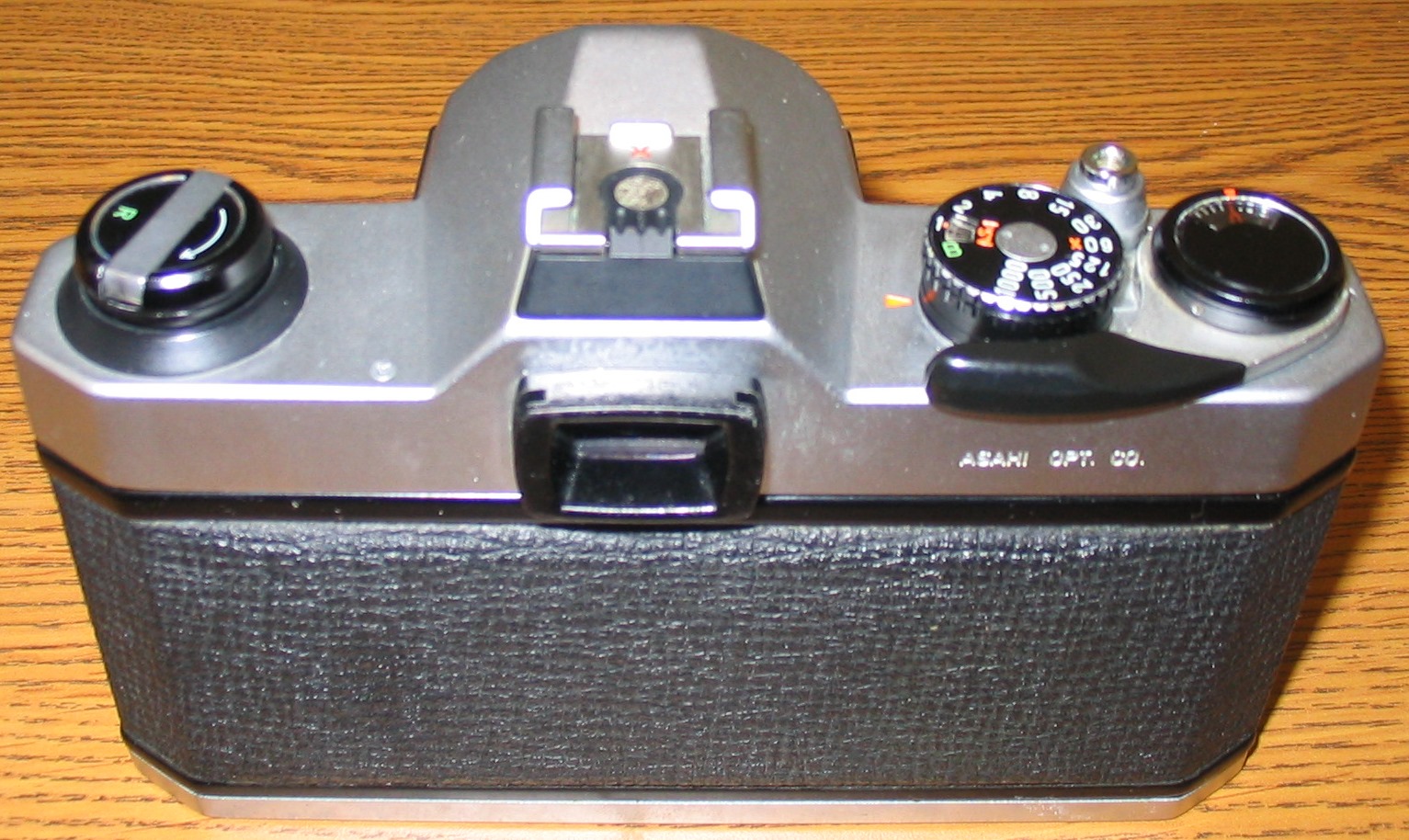
The User's Review: Special Edition of Pentax K1000: K1000 SE


The facts and questions about Pentax K1000 and K1000 SE:
1.  First produced in Japan in 1976, later assembled in Hong Kong (1978 -) and China (1990 - 1997).
2. More than 3 million bodies were built in the ~20 years (on average, 150 thousands per yr).
3. Three differences between K1000 and K1000 SE include: ‘SE’ labeled on the top cover; microprism  spot on K1000 focusing screen vs. horizontally-split image with microprism collar in K1000 SE; brown skins of earlier-produced K1000 SE.
4. When was K1000 SE first made? 1979 (?) since one of K1000 SE owners told me that he brought it in the year.
5. If you get a chance to pick up one from the two, which one should you take?
    My answer is K1000 SE because of its split focusing screen, especially for low light conditions. 


Both of my K1000 SE (7451xxx) and K1000 (7148xxx) have been engraved their SN on the bottom plates with a sticker 'Assembled in Hong Kong'. I also have a blog page on Pentax K1000.
(5.99)

Thursday, March 14, 2013

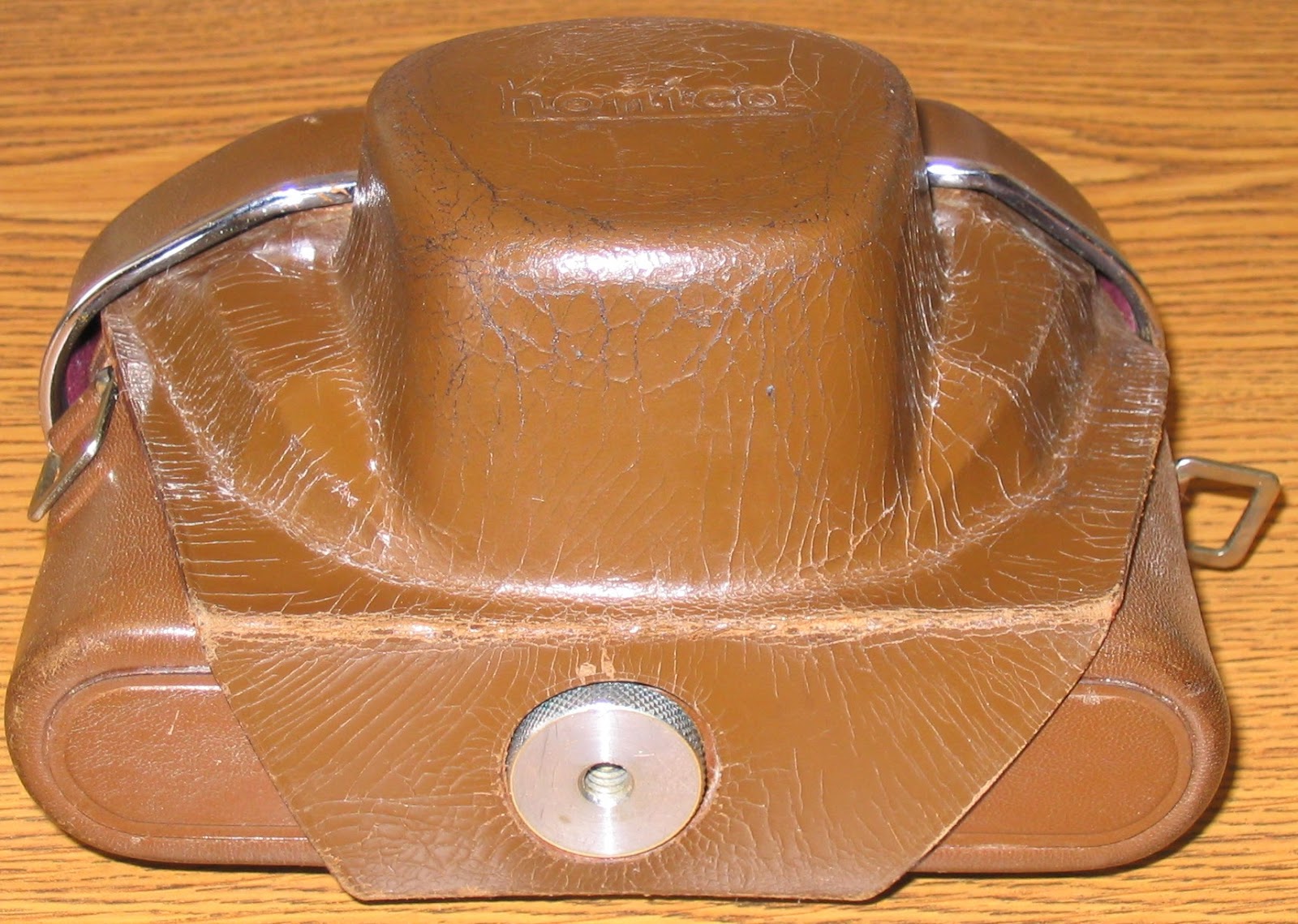
The User's Review: Konica IIIM 35 mm Full or Single (Or Reduced-Size) Frame Rangefinder Rangefinder Camera, Released in March of 1959


The first thing to talk about here is the Konica/Konishiroku logo at the time of IIIM in production.  The Japanese character (the same as the Chinese) means six, yes number 6. It's one of the characters in the company's Japanese names (小西) and a lucky number in the cultures?


Konica ad in a magazine of Nov., 1959 
The second thing here about this camera is the price. According to DollarTimes.com, $129.95 in 1959 should be priced at $1032.41 in 2013.


The third thing to mention here is the Konica-called 'Single-Frame Mask'. Once installed, it reduces the frame size to 17 X 24 mm as stated in P. 32 of IIIM manual. This frame size is actually smaller than the real half frame of 18 X 24. Therefore, Konica IIIM should not be referred as a 35 mm half-frame camera.


The forth thing I noticed about this camera is that many users use and talk online about IIIM, but, so far, there is nowhere to find its manual free on the net. I got my used IIIM with not only all pieces but also every original papers, 55 years after 1959.


After the years, my IIIM still feels strong. However, aging issues are developing. The light sensing panel does not work although the inboard meter seems to be OK as I tested my IIIM. As I learned, there are some other issues with old IIIMs, including missing single-frame mask, failed shutter, broken light panel frame (made of plastic) and .... IIIM has a non-standard hot shoe, matching the OEM bulb flash, Koniflash III. A dedicated 'Auto-up' device, by focusing through the IIIM range finder, covers ranges of 14 - 20 and 20 - 40 inches for close-up pictures. These two accessories may not easy to find.  


Monday, January 28, 2013

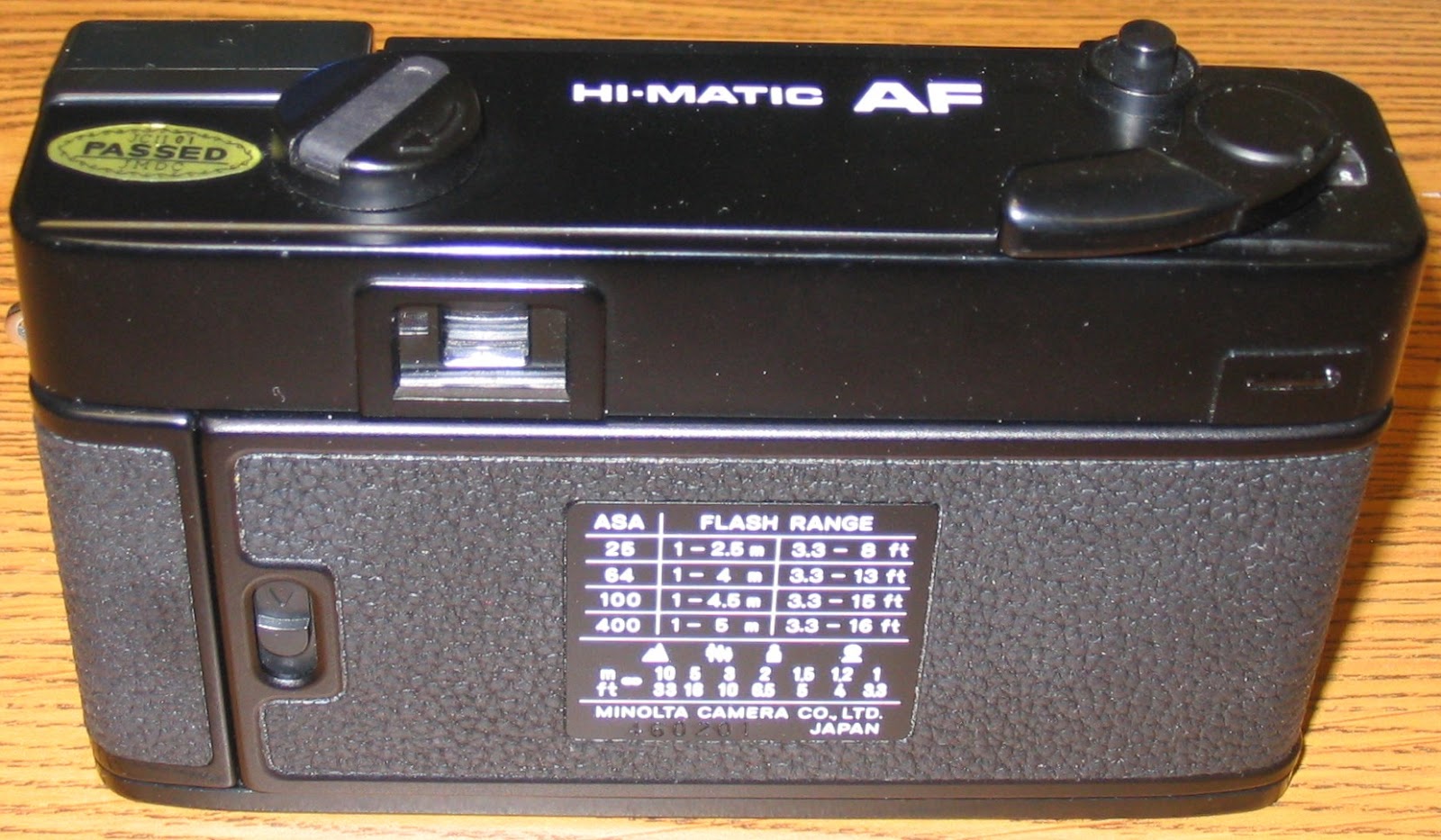
The User's Review: Minolta Hi-Matic AF 35 mm Camera, Released in 1979

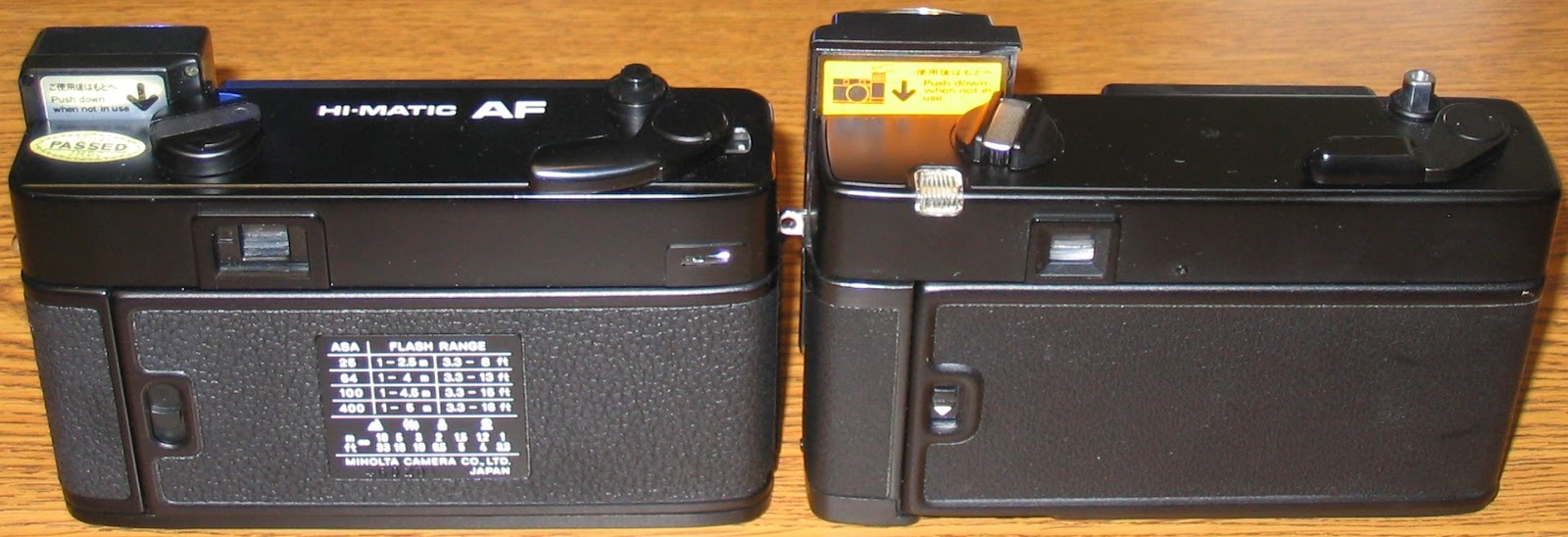
Hi-Matic AF is the first model with auto-focus in Minolta Hi-Matic series. When Hi-Matic AF was in my hands, it reminded me Konica C35 AF, the first mass-produced AF camera.

Minolta Hi-Matic AF comes with a multi-coated Minolta Rokker 38 mm f2.8 lens and with ASA range of 25 - 400. The inboard flash has to be turned on manually. Other features include self-timer, focus lock, mental tripod socket and 2 AA batteries.

Like Konica C35 AF, Hi-Matic AF also takes 46 mm filter. On both models, the light eyes will be covered by the filter used. Therefore, the user does not need to worry about the auto-metering when using a filter. Both models have a dedicated lens cap. I should call them 'front masks' because they cover not only the lenses, but also the windows of rangefinders and focusing systems. The front mask on Minolta Hi-Matic AF even protects the shutter button from accident release. A good design is that the Hi-Matic AF bottom case has a hanging to keep the mask from missing. 

Unlike Konica C35 AF, Hi-Matic AF can't accept a shutter release cable, but its self-timer may be more helpful in daily use.